Year 5 Maths Assessment
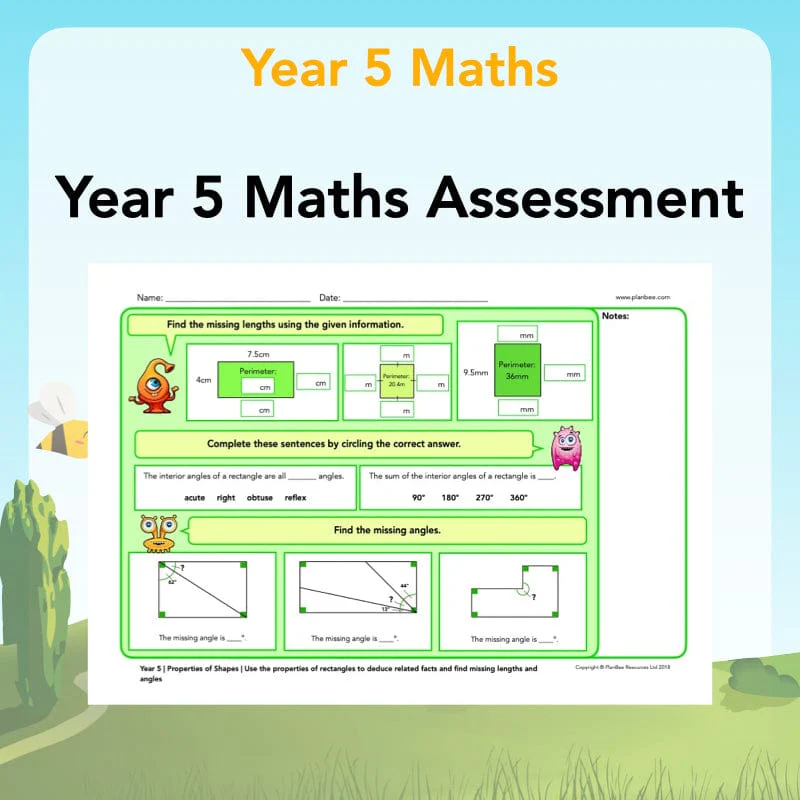
This Year 5 Maths Assessment pack is designed to assess your children's understanding of every single one of the Year 5 Maths objectives in the new curriculum (2014). It provides a fun, flexible way to assess pupils' confidence in each area of the Maths curriculum, helping you to identify both gaps in understanding and areas of strength. Each of the Year 5 Maths objectives is assessed over a single printable page through questions, puzzles, challenges and activities.
Perfect as an early morning starter, homework activity, baseline assessment, or in a more formal assessment setting, these Year 5 Maths Assessment sheets can be used in a variety of ways to assess your class against the new curriculum objectives for Year 5 Maths.
What's included:
- 51 full colour assessment sheets
- 51 black and white assessment sheets
- Answer sheets
- Objectives overview
- Objectives record sheet
Free Additional Resources
Download a free Maths assessment record to help keep track of your children's progress.
Curriculum Objectives Covered
- Year 5 - read, write, order and compare numbers to at least 1 000 000 and determine the value of each digit
- Year 5 - count forwards or backwards in steps of powers of 10 for any given number up to 1 000 000
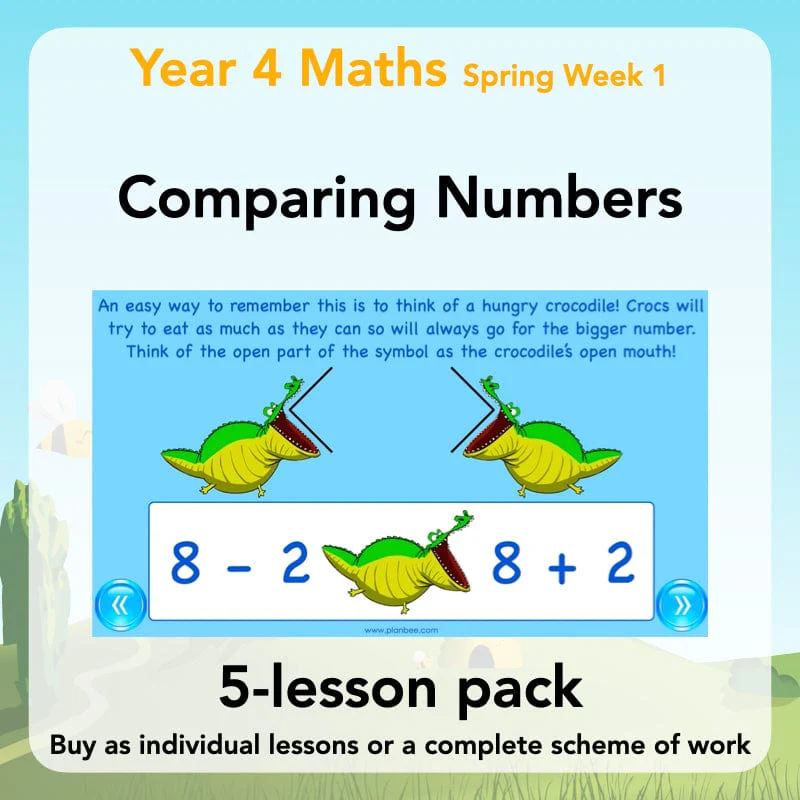
- Year 5 - interpret negative numbers in context, count forwards and backwards with positive and negative whole numbers, including through zero
- Year 5 - round any number up to 1 000 000 to the nearest 10, 100, 1000, 10 000 and 100 000
- Year 5 - solve number problems and practical problems that involve all of the above
- Year 5 - read Roman numerals to 1000 (M) and recognise years written in Roman numerals
- Year 5 - add and subtract whole numbers with more than 4 digits, including using formal written methods (columnar addition and subtraction)
- Year 5 - add and subtract numbers mentally with increasingly large numbers
- Year 5 - use rounding to check answers to calculations and determine, in the context of a problem, levels of accuracy
- Year 5 - solve addition and subtraction multi-step problems in contexts, deciding which operations and methods to use and why
- Year 5 - identify multiples and factors, including finding all factor pairs of a number, and common factors of two numbers
- Year 5 - know and use the vocabulary of prime numbers, prime factors and composite (non-prime) numbers
- Year 5 - establish whether a number up to 100 is prime and recall prime numbers up to 19
- Year 5 - multiply numbers up to 4 digits by a one- or two-digit number using a formal written method, including long multiplication for two-digit numbers
- Year 5 - multiply and divide numbers mentally drawing upon known facts
- Year 5 - divide numbers up to 4 digits by a one-digit number using the formal written method of short division and interpret remainders appropriately for the context
- Year 5 - multiply and divide whole numbers and those involving decimals by 10, 100 and 1000
- Year 5 - compare and order fractions whose denominators are all multiples of the same number
- Year 5 - identify, name and write equivalent fractions of a given fraction, represented visually, including tenths and hundredths
- Year 5 - recognise mixed numbers and improper fractions and convert from one form to the other and write mathematical statements > 1 as a mixed number
- Year 5 - add and subtract fractions with the same denominator and denominators that are multiples of the same number
- Year 5 - multiply proper fractions and mixed numbers by whole numbers, supported by materials and diagrams
- Year 5 - read and write decimal numbers as fractions
- Year 5 - recognise and use thousandths and relate them to tenths, hundredths and decimal equivalents
- Year 5 - round decimals with two decimal places to the nearest whole number and to one decimal place
- Year 5 - read, write, order and compare numbers with up to three decimal places
- Year 5 - solve problems involving number up to three decimal places
- Year 5 - recognise the per cent symbol (%) and understand that per cent relates to ‘number of parts per hundred’, and write percentages as a fraction with denominator 100, and as a decimal
- Year 5 - solve problems which require knowing percentage and decimal equivalents of 1/2, 1/4, 1/5, 2/5, 4/5 and those fractions with a denominator of a multiple of 10 or 25
- Year 5 - convert between different units of metric measure (for example, kilometre and metre; centimetre and metre; centimetre and millimetre; gram and kilogram; litre and millilitre)
- Year 5 - understand and use approximate equivalences between metric units and common imperial units such as inches, pounds and pints
- Year 5 - measure and calculate the perimeter of composite rectilinear shapes in centimetres and metres
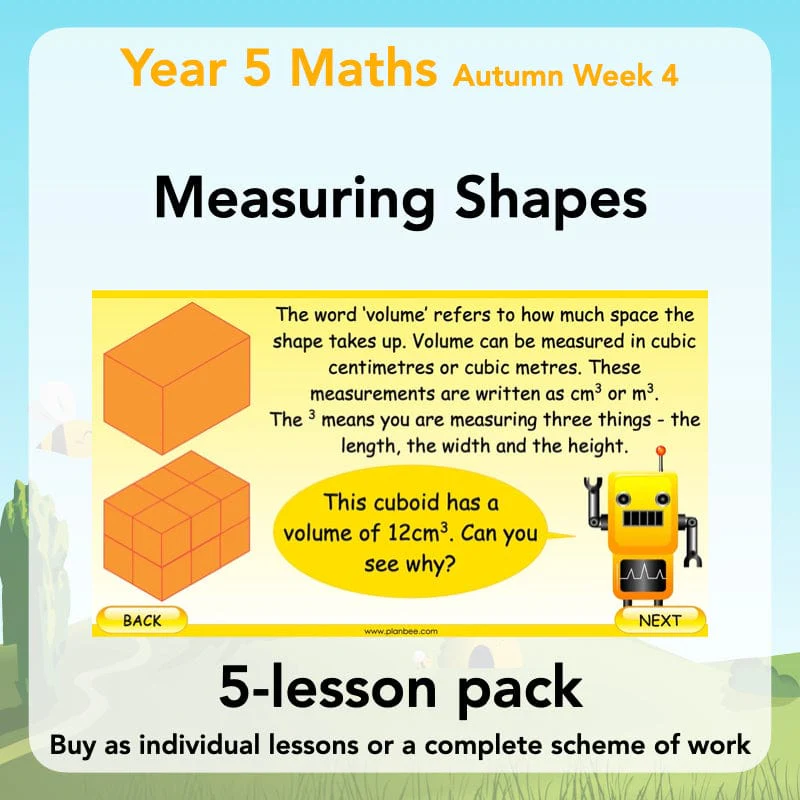
- Year 5 - calculate and compare the area of rectangles (including squares), and including using standard units, square centimetres (cm²) and square metres (m2) and estimate the area of irregular shapes
- Year 5 - estimate volume and capacity
- Year 5 - solve problems involving converting between units of time
- Year 5 - use all four operations to solve problems involving measure using decimal notation, including scaling
- Year 5 - identify 3-D shapes, including cubes and other cuboids, from 2-D representations
- Year 5 - know angles are measured in degrees: estimate and compare acute, obtuse and reflex angles
- Year 5 - draw given angles, and measure them in degrees (°)
- Year 5 - identify angles at a point and one whole turn (total 360°)
- Year 5 - identify angles at a point on a straight line and 1/2 a turn (total 180°)
- Year 5 - identify other multiples of 90°
- Year 5 - use the properties of rectangles to deduce related facts and find missing lengths and angles
- Year 5 - distinguish between regular and irregular polygons based on reasoning about equal sides and angles
- Year 5 - identify, describe and represent the position of a shape following a reflection or translation, using the appropriate language, and know that the shape has not changed
- Year 5 - solve comparison, sum and difference problems using information presented in a line graph
- Year 5 - complete, read and interpret information in tables, including timetables
- Year 5 - recognise and use square numbers and cube numbers, and the notation for squared (²) and cubed (³)
- Year 5 - solve problems involving multiplication and division including using their knowledge of factors and multiples, squares and cubes
- Year 5 - solve problems involving addition, subtraction, multiplication and division and a combination of these, including understanding the meaning of the equals sign
- Year 5 - solve problems involving multiplication and division, including scaling by simple fractions and problems involving simple rates
This Year 5 Maths Assessment pack is designed to assess your children's understanding of every single one of the Year 5 Maths objectives in the new curriculum (2014). It provides a fun, flexible way to assess pupils' confidence in each area of the Maths curriculum, helping you to identify both gaps in understanding and areas of strength. Each of the Year 5 Maths objectives is assessed over a single printable page through questions, puzzles, challenges and activities.
Perfect as an early morning starter, homework activity, baseline assessment, or in a more formal assessment setting, these Year 5 Maths Assessment sheets can be used in a variety of ways to assess your class against the new curriculum objectives for Year 5 Maths.
What's included:
- 51 full colour assessment sheets
- 51 black and white assessment sheets
- Answer sheets
- Objectives overview
- Objectives record sheet
Free Additional Resources
Download a free Maths assessment record to help keep track of your children's progress.
Curriculum Objectives Covered
- Year 5 - read, write, order and compare numbers to at least 1 000 000 and determine the value of each digit
- Year 5 - count forwards or backwards in steps of powers of 10 for any given number up to 1 000 000
- Year 5 - interpret negative numbers in context, count forwards and backwards with positive and negative whole numbers, including through zero
- Year 5 - round any number up to 1 000 000 to the nearest 10, 100, 1000, 10 000 and 100 000
- Year 5 - solve number problems and practical problems that involve all of the above
- Year 5 - read Roman numerals to 1000 (M) and recognise years written in Roman numerals
- Year 5 - add and subtract whole numbers with more than 4 digits, including using formal written methods (columnar addition and subtraction)
- Year 5 - add and subtract numbers mentally with increasingly large numbers
- Year 5 - use rounding to check answers to calculations and determine, in the context of a problem, levels of accuracy
- Year 5 - solve addition and subtraction multi-step problems in contexts, deciding which operations and methods to use and why
- Year 5 - identify multiples and factors, including finding all factor pairs of a number, and common factors of two numbers
- Year 5 - know and use the vocabulary of prime numbers, prime factors and composite (non-prime) numbers
- Year 5 - establish whether a number up to 100 is prime and recall prime numbers up to 19
- Year 5 - multiply numbers up to 4 digits by a one- or two-digit number using a formal written method, including long multiplication for two-digit numbers
- Year 5 - multiply and divide numbers mentally drawing upon known facts
- Year 5 - divide numbers up to 4 digits by a one-digit number using the formal written method of short division and interpret remainders appropriately for the context
- Year 5 - multiply and divide whole numbers and those involving decimals by 10, 100 and 1000
- Year 5 - compare and order fractions whose denominators are all multiples of the same number
- Year 5 - identify, name and write equivalent fractions of a given fraction, represented visually, including tenths and hundredths
- Year 5 - recognise mixed numbers and improper fractions and convert from one form to the other and write mathematical statements > 1 as a mixed number
- Year 5 - add and subtract fractions with the same denominator and denominators that are multiples of the same number
- Year 5 - multiply proper fractions and mixed numbers by whole numbers, supported by materials and diagrams
- Year 5 - read and write decimal numbers as fractions
- Year 5 - recognise and use thousandths and relate them to tenths, hundredths and decimal equivalents
- Year 5 - round decimals with two decimal places to the nearest whole number and to one decimal place
- Year 5 - read, write, order and compare numbers with up to three decimal places
- Year 5 - solve problems involving number up to three decimal places
- Year 5 - recognise the per cent symbol (%) and understand that per cent relates to ‘number of parts per hundred’, and write percentages as a fraction with denominator 100, and as a decimal
- Year 5 - solve problems which require knowing percentage and decimal equivalents of 1/2, 1/4, 1/5, 2/5, 4/5 and those fractions with a denominator of a multiple of 10 or 25
- Year 5 - convert between different units of metric measure (for example, kilometre and metre; centimetre and metre; centimetre and millimetre; gram and kilogram; litre and millilitre)
- Year 5 - understand and use approximate equivalences between metric units and common imperial units such as inches, pounds and pints
- Year 5 - measure and calculate the perimeter of composite rectilinear shapes in centimetres and metres
- Year 5 - calculate and compare the area of rectangles (including squares), and including using standard units, square centimetres (cm²) and square metres (m2) and estimate the area of irregular shapes
- Year 5 - estimate volume and capacity
- Year 5 - solve problems involving converting between units of time
- Year 5 - use all four operations to solve problems involving measure using decimal notation, including scaling
- Year 5 - identify 3-D shapes, including cubes and other cuboids, from 2-D representations
- Year 5 - know angles are measured in degrees: estimate and compare acute, obtuse and reflex angles
- Year 5 - draw given angles, and measure them in degrees (°)
- Year 5 - identify angles at a point and one whole turn (total 360°)
- Year 5 - identify angles at a point on a straight line and 1/2 a turn (total 180°)
- Year 5 - identify other multiples of 90°
- Year 5 - use the properties of rectangles to deduce related facts and find missing lengths and angles
- Year 5 - distinguish between regular and irregular polygons based on reasoning about equal sides and angles
- Year 5 - identify, describe and represent the position of a shape following a reflection or translation, using the appropriate language, and know that the shape has not changed
- Year 5 - solve comparison, sum and difference problems using information presented in a line graph
- Year 5 - complete, read and interpret information in tables, including timetables
- Year 5 - recognise and use square numbers and cube numbers, and the notation for squared (²) and cubed (³)
- Year 5 - solve problems involving multiplication and division including using their knowledge of factors and multiples, squares and cubes
- Year 5 - solve problems involving addition, subtraction, multiplication and division and a combination of these, including understanding the meaning of the equals sign
- Year 5 - solve problems involving multiplication and division, including scaling by simple fractions and problems involving simple rates
Original: $16.29
-65%$16.29
$5.70Description
This Year 5 Maths Assessment pack is designed to assess your children's understanding of every single one of the Year 5 Maths objectives in the new curriculum (2014). It provides a fun, flexible way to assess pupils' confidence in each area of the Maths curriculum, helping you to identify both gaps in understanding and areas of strength. Each of the Year 5 Maths objectives is assessed over a single printable page through questions, puzzles, challenges and activities.
Perfect as an early morning starter, homework activity, baseline assessment, or in a more formal assessment setting, these Year 5 Maths Assessment sheets can be used in a variety of ways to assess your class against the new curriculum objectives for Year 5 Maths.
What's included:
- 51 full colour assessment sheets
- 51 black and white assessment sheets
- Answer sheets
- Objectives overview
- Objectives record sheet
Free Additional Resources
Download a free Maths assessment record to help keep track of your children's progress.
Curriculum Objectives Covered
- Year 5 - read, write, order and compare numbers to at least 1 000 000 and determine the value of each digit
- Year 5 - count forwards or backwards in steps of powers of 10 for any given number up to 1 000 000
- Year 5 - interpret negative numbers in context, count forwards and backwards with positive and negative whole numbers, including through zero
- Year 5 - round any number up to 1 000 000 to the nearest 10, 100, 1000, 10 000 and 100 000
- Year 5 - solve number problems and practical problems that involve all of the above
- Year 5 - read Roman numerals to 1000 (M) and recognise years written in Roman numerals
- Year 5 - add and subtract whole numbers with more than 4 digits, including using formal written methods (columnar addition and subtraction)
- Year 5 - add and subtract numbers mentally with increasingly large numbers
- Year 5 - use rounding to check answers to calculations and determine, in the context of a problem, levels of accuracy
- Year 5 - solve addition and subtraction multi-step problems in contexts, deciding which operations and methods to use and why
- Year 5 - identify multiples and factors, including finding all factor pairs of a number, and common factors of two numbers
- Year 5 - know and use the vocabulary of prime numbers, prime factors and composite (non-prime) numbers
- Year 5 - establish whether a number up to 100 is prime and recall prime numbers up to 19
- Year 5 - multiply numbers up to 4 digits by a one- or two-digit number using a formal written method, including long multiplication for two-digit numbers
- Year 5 - multiply and divide numbers mentally drawing upon known facts
- Year 5 - divide numbers up to 4 digits by a one-digit number using the formal written method of short division and interpret remainders appropriately for the context
- Year 5 - multiply and divide whole numbers and those involving decimals by 10, 100 and 1000
- Year 5 - compare and order fractions whose denominators are all multiples of the same number
- Year 5 - identify, name and write equivalent fractions of a given fraction, represented visually, including tenths and hundredths
- Year 5 - recognise mixed numbers and improper fractions and convert from one form to the other and write mathematical statements > 1 as a mixed number
- Year 5 - add and subtract fractions with the same denominator and denominators that are multiples of the same number
- Year 5 - multiply proper fractions and mixed numbers by whole numbers, supported by materials and diagrams
- Year 5 - read and write decimal numbers as fractions
- Year 5 - recognise and use thousandths and relate them to tenths, hundredths and decimal equivalents
- Year 5 - round decimals with two decimal places to the nearest whole number and to one decimal place
- Year 5 - read, write, order and compare numbers with up to three decimal places
- Year 5 - solve problems involving number up to three decimal places
- Year 5 - recognise the per cent symbol (%) and understand that per cent relates to ‘number of parts per hundred’, and write percentages as a fraction with denominator 100, and as a decimal
- Year 5 - solve problems which require knowing percentage and decimal equivalents of 1/2, 1/4, 1/5, 2/5, 4/5 and those fractions with a denominator of a multiple of 10 or 25
- Year 5 - convert between different units of metric measure (for example, kilometre and metre; centimetre and metre; centimetre and millimetre; gram and kilogram; litre and millilitre)
- Year 5 - understand and use approximate equivalences between metric units and common imperial units such as inches, pounds and pints
- Year 5 - measure and calculate the perimeter of composite rectilinear shapes in centimetres and metres
- Year 5 - calculate and compare the area of rectangles (including squares), and including using standard units, square centimetres (cm²) and square metres (m2) and estimate the area of irregular shapes
- Year 5 - estimate volume and capacity
- Year 5 - solve problems involving converting between units of time
- Year 5 - use all four operations to solve problems involving measure using decimal notation, including scaling
- Year 5 - identify 3-D shapes, including cubes and other cuboids, from 2-D representations
- Year 5 - know angles are measured in degrees: estimate and compare acute, obtuse and reflex angles
- Year 5 - draw given angles, and measure them in degrees (°)
- Year 5 - identify angles at a point and one whole turn (total 360°)
- Year 5 - identify angles at a point on a straight line and 1/2 a turn (total 180°)
- Year 5 - identify other multiples of 90°
- Year 5 - use the properties of rectangles to deduce related facts and find missing lengths and angles
- Year 5 - distinguish between regular and irregular polygons based on reasoning about equal sides and angles
- Year 5 - identify, describe and represent the position of a shape following a reflection or translation, using the appropriate language, and know that the shape has not changed
- Year 5 - solve comparison, sum and difference problems using information presented in a line graph
- Year 5 - complete, read and interpret information in tables, including timetables
- Year 5 - recognise and use square numbers and cube numbers, and the notation for squared (²) and cubed (³)
- Year 5 - solve problems involving multiplication and division including using their knowledge of factors and multiples, squares and cubes
- Year 5 - solve problems involving addition, subtraction, multiplication and division and a combination of these, including understanding the meaning of the equals sign
- Year 5 - solve problems involving multiplication and division, including scaling by simple fractions and problems involving simple rates