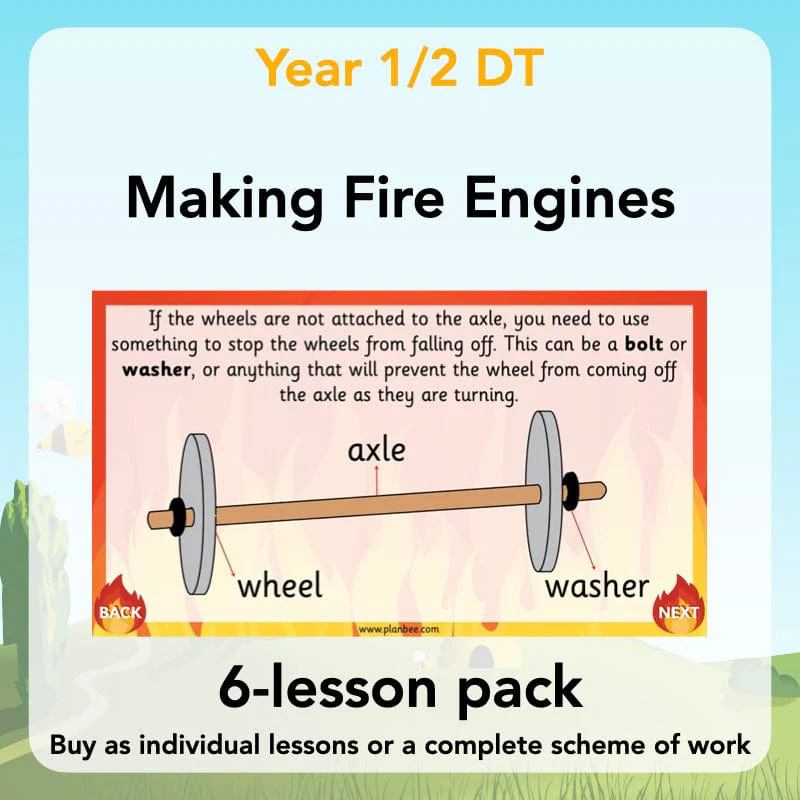
Making Fire Engines
Get your children excited about fire engines with this fun ‘Making Fire Engines’ DT scheme of work for KS1. Your class will explore modern fire engines and their features, before exploring, designing, creating and evaluating their own model fire engine using wheels, axles and chassis. There’s the option to look at 17th century fire engines too as part of a ‘Great Fire of London’ topic. Containing lesson plans, presentations and printable resources, these fun and engaging lessons are pre-prepared so you can get on with teaching and your class can get on with learning!
You may also like our Great Fire of London Topic Bundle - four ready-to-teach schemes of work for History, Art, DT and Geography to perfectly fit your Great Fire of London topic.
A Knowledge Organiser is available to support the learning in this scheme. It is included in the Complete Series download or can be purchased individually.
Teaching the Great Fire of London in KS1?
Looking for topic facts, classroom activities and a free starter lesson?
👉 Explore our complete Great Fire of London KS1 guide
Exploring Fire Engines
In the first lesson in this series, children will explore modern fire engines and their features, looking at what features are common to all vehicles and which are specific to fire engines. There is also the opportunity to look at a 17th century fire engine to compare how they are similar and different to modern fire engines.
What's included:
- Lesson plan
- Slides
- Activity ideas
- Differentiated worksheets
- Label cards
- Picture cards
View Lesson 1
Wheels, Axles and Chassis
In this lesson, children will explore how wheels, axles and chassis work together to create the base of a fire engine. They will explore different ways of attaching the chassis to the axles using different methods and materials.
What's included:
- Lesson plan
- Slides
- Activity ideas
- Challenge sheet
- Differentiated worksheets
View Lesson 2
Body Building
Children will investigate different ways of creating the body of a fire engine, using materials such as cardboard boxes, lolly sticks and other craft materials. They will explore how to create features such as ladders and fire hoses, considering which materials and tools are best suited for different tasks.
What's included:
- Lesson plan
- Slides
- Activity ideas
- Differentiated challenge cards
- Differentiated worksheets
View Lesson 3
Our Designs
Now that your class have investigated some of the different materials, tools and methods they will use for constructing a fire engine, they will have the chance to complete a design. Children are challenged to either design a modern fire engine or a 17th century fire engine.
What's included:
- Lesson plan
- Slides
- Activity ideas
- Differentiated worksheets
- Picture cards
View Lesson 4
Creation
And now for the fun part! Using their designs from the previous lesson, children work to design criteria to create their moving fire engines using a variety of materials, tools and techniques.
What's included:
- Lesson plan
- Slides
- Activity ideas
View Lesson 5
Evaluation
In the final lesson in this series, children will evaluate their own fire engines, as well as fire engines made by their peers. They will consider what went well, what could be improved upon and what they could do differently if they were to make their fire engines again.
What's included:
- Lesson plan
- Slides
- Activity ideas
- Differentiated worksheets
- Question cards
View Lesson 6
This Year 1/2 Design and Technology Knowledge Organiser has been created to complement our DT Mechanisms and Mechanical Systems strand. It is designed to support your children’s understanding of key vocabulary and techniques linked to this scheme of work. Key questions and relevant technical skills have been identified to encourage children to apply their knowledge around this topic.
View Knowledge Organiser
Get your children excited about fire engines with this fun ‘Making Fire Engines’ DT scheme of work for KS1. Your class will explore modern fire engines and their features, before exploring, designing, creating and evaluating their own model fire engine using wheels, axles and chassis. There’s the option to look at 17th century fire engines too as part of a ‘Great Fire of London’ topic. Containing lesson plans, presentations and printable resources, these fun and engaging lessons are pre-prepared so you can get on with teaching and your class can get on with learning!
You may also like our Great Fire of London Topic Bundle - four ready-to-teach schemes of work for History, Art, DT and Geography to perfectly fit your Great Fire of London topic.
A Knowledge Organiser is available to support the learning in this scheme. It is included in the Complete Series download or can be purchased individually.
Teaching the Great Fire of London in KS1?
Looking for topic facts, classroom activities and a free starter lesson?
👉 Explore our complete Great Fire of London KS1 guide
Exploring Fire Engines
In the first lesson in this series, children will explore modern fire engines and their features, looking at what features are common to all vehicles and which are specific to fire engines. There is also the opportunity to look at a 17th century fire engine to compare how they are similar and different to modern fire engines.
What's included:
- Lesson plan
- Slides
- Activity ideas
- Differentiated worksheets
- Label cards
- Picture cards
View Lesson 1
Wheels, Axles and Chassis
In this lesson, children will explore how wheels, axles and chassis work together to create the base of a fire engine. They will explore different ways of attaching the chassis to the axles using different methods and materials.
What's included:
- Lesson plan
- Slides
- Activity ideas
- Challenge sheet
- Differentiated worksheets
View Lesson 2
Body Building
Children will investigate different ways of creating the body of a fire engine, using materials such as cardboard boxes, lolly sticks and other craft materials. They will explore how to create features such as ladders and fire hoses, considering which materials and tools are best suited for different tasks.
What's included:
- Lesson plan
- Slides
- Activity ideas
- Differentiated challenge cards
- Differentiated worksheets
View Lesson 3
Our Designs
Now that your class have investigated some of the different materials, tools and methods they will use for constructing a fire engine, they will have the chance to complete a design. Children are challenged to either design a modern fire engine or a 17th century fire engine.
What's included:
- Lesson plan
- Slides
- Activity ideas
- Differentiated worksheets
- Picture cards
View Lesson 4
Creation
And now for the fun part! Using their designs from the previous lesson, children work to design criteria to create their moving fire engines using a variety of materials, tools and techniques.
What's included:
- Lesson plan
- Slides
- Activity ideas
View Lesson 5
Evaluation
In the final lesson in this series, children will evaluate their own fire engines, as well as fire engines made by their peers. They will consider what went well, what could be improved upon and what they could do differently if they were to make their fire engines again.
What's included:
- Lesson plan
- Slides
- Activity ideas
- Differentiated worksheets
- Question cards
View Lesson 6
This Year 1/2 Design and Technology Knowledge Organiser has been created to complement our DT Mechanisms and Mechanical Systems strand. It is designed to support your children’s understanding of key vocabulary and techniques linked to this scheme of work. Key questions and relevant technical skills have been identified to encourage children to apply their knowledge around this topic.
View Knowledge Organiser
Original: $2.70
-65%$2.70
$0.94Description
Get your children excited about fire engines with this fun ‘Making Fire Engines’ DT scheme of work for KS1. Your class will explore modern fire engines and their features, before exploring, designing, creating and evaluating their own model fire engine using wheels, axles and chassis. There’s the option to look at 17th century fire engines too as part of a ‘Great Fire of London’ topic. Containing lesson plans, presentations and printable resources, these fun and engaging lessons are pre-prepared so you can get on with teaching and your class can get on with learning!
You may also like our Great Fire of London Topic Bundle - four ready-to-teach schemes of work for History, Art, DT and Geography to perfectly fit your Great Fire of London topic.
A Knowledge Organiser is available to support the learning in this scheme. It is included in the Complete Series download or can be purchased individually.
Teaching the Great Fire of London in KS1?
Looking for topic facts, classroom activities and a free starter lesson?
👉 Explore our complete Great Fire of London KS1 guide
Exploring Fire Engines
In the first lesson in this series, children will explore modern fire engines and their features, looking at what features are common to all vehicles and which are specific to fire engines. There is also the opportunity to look at a 17th century fire engine to compare how they are similar and different to modern fire engines.
What's included:
- Lesson plan
- Slides
- Activity ideas
- Differentiated worksheets
- Label cards
- Picture cards
View Lesson 1
Wheels, Axles and Chassis
In this lesson, children will explore how wheels, axles and chassis work together to create the base of a fire engine. They will explore different ways of attaching the chassis to the axles using different methods and materials.
What's included:
- Lesson plan
- Slides
- Activity ideas
- Challenge sheet
- Differentiated worksheets
View Lesson 2
Body Building
Children will investigate different ways of creating the body of a fire engine, using materials such as cardboard boxes, lolly sticks and other craft materials. They will explore how to create features such as ladders and fire hoses, considering which materials and tools are best suited for different tasks.
What's included:
- Lesson plan
- Slides
- Activity ideas
- Differentiated challenge cards
- Differentiated worksheets
View Lesson 3
Our Designs
Now that your class have investigated some of the different materials, tools and methods they will use for constructing a fire engine, they will have the chance to complete a design. Children are challenged to either design a modern fire engine or a 17th century fire engine.
What's included:
- Lesson plan
- Slides
- Activity ideas
- Differentiated worksheets
- Picture cards
View Lesson 4
Creation
And now for the fun part! Using their designs from the previous lesson, children work to design criteria to create their moving fire engines using a variety of materials, tools and techniques.
What's included:
- Lesson plan
- Slides
- Activity ideas
View Lesson 5
Evaluation
In the final lesson in this series, children will evaluate their own fire engines, as well as fire engines made by their peers. They will consider what went well, what could be improved upon and what they could do differently if they were to make their fire engines again.
What's included:
- Lesson plan
- Slides
- Activity ideas
- Differentiated worksheets
- Question cards
View Lesson 6
This Year 1/2 Design and Technology Knowledge Organiser has been created to complement our DT Mechanisms and Mechanical Systems strand. It is designed to support your children’s understanding of key vocabulary and techniques linked to this scheme of work. Key questions and relevant technical skills have been identified to encourage children to apply their knowledge around this topic.
View Knowledge Organiser